A few weeks ago I turned up this typescript, which was my first submission to Interzone, and indeed my first submission to any kind of paying market. The story was written at the end of 1985, and submitted at the start of the new year of 1986, making it almost exactly thirty years old. I make no claims for the quality of the story; indeed - as you'll see - it was rejected, and its flaws were obvious enough to me even then, sufficiently so that I made no effort to rework it. But hopefully it's of some interest as an early effort, and scholars of Revelation Space will find one of the character names significant. If nothing else, it's an object lesson in how not to format a short fiction submission ....
(Edit - struggling to find a good way to both display these images and have them appear at a useful size for reading. Bear with me...)
Friday, 18 December 2015
Monday, 14 December 2015
Asimov's - August 2015
The August issue is a particularly strong one. Earlier this year I lavished praise on Nick Wolven's "On The Night of The Robo-Bulls and the Zombie Dancers", and Wolven's lead piece in this issue - the equally awkwardly titled "No Placeholder For You, My Love", while shorter, is no less strong. We meet the protagonist, Claire, at a dinner party in what appears to be New Orleans, where Claire in turn meets Byron, a mysterious and attractive stranger, but before long we're being clued in that all is not what it seems: "She lifted her glass of wine to her mouth, and the liquid vanished the instant it touched her tongue." Claire, we soon realise, is - along with Byron and everyone else she meets - embedded in a kind of virtual reality simulation, an elaborate construct with a particular set of rules, and which exists to serve the emotional needs of the real people existing beyond the simulation. For the versions of Claire and Byron inside the construct, life is a joyless shuffle of romantic permutations, endless parties, endless encounters with prospective partners, with each new roll of the dice signalled by the bells of the midnight chime. To say more would be to spoil the pleasures of discovering Wolven's premise, but Claire and Byron - after being separated and thrown back together again - gradually come to a tentative understanding of the parameters of their world, and develop a plan to exploit a latent flaw in the environment. However, things don't quite go as intended. Wolven has a heady, sensuous style, displayed to good effect in both of his Asimov's stories, each of which is saturated with the heat and mystery of long sultry nights: "The breath of the bayou was in the air, warm and buoyant, holding up the clustered leaves of the pecan trees and the high, star-scattered sky." It's a story which is as much about atmosphere as the science fictional mechanics of the setting, and I enjoyed it tremendously.
Every now and then I'm in exactly the right mood for a piece of bleak, dystopian writing, and Kelly Robson's piece came along just at the right time. "Two-Year Man" is the first of hers that I've read, and it's very good indeed, even if I'm sure that I'll unpack rather more from the story on a third read. This is a bracingly sad story about Mikkel, a "two-year man" - the title refers to the time served in some kind of military campaign, in what appears to be an openly anti-semitic future or alternate history - who is at the absolute bottom of the barrel compared to the four, six and even eight-year men above him. At home is Anna, Mikkel's childless wife. When Mikkel rescues a kind of baby - a "taint" - from the lab where he does menial work, he thinks at first that it will make Anna happy. But the baby is an odd, reptilian thing, possessed of a beak and talons, something which is accepted largely without comment by Anna and Mikkel's friend Hyam. That's one of this story's considerable strengths, in fact: the way it refuses to explain itself, or defend its worldbuilding with lengthy interjections. The writing is enjoyably downbeat, striking an almost Lynchian air of grim fatalism:
"Appel strudel," grunted Hermann, the four-year man in charge of the early morning guard shift. "Those pasty scientists don't know good eats. Imagine leaving strudel to sit."
"Café Sluka has the best strudel in Vienna, so everyone says," Mikkel said as he passed through the security gate.
"Like you'd know, moron. Wouldn't let you through the door."
Mikkel ducked his head and kept his eyes on the floor. "I heated them in the microwave for you."
He rushed out into the grey winter light as the guards munched warm strudel.
In the interests of transparency I should probably mention that Paul McAuley is an old friend, someone whose career I've been following with admiration for more than thirty years, ever since his story "Little Ilya and Spider and Box" broke ground in Interzone by being actual honest-to-god science fiction set in the future with spaceports and interstellar travel and so on. But the fact is that better writers and critics than me have praised his work, both at novel and shorter length, and it's no real surprise that a McAuley piece delivers the goods, even if you can't ever be sure quite what you're going to get from him. If there's a common thread, it's that it's often Hard SF, but in which the speculative conceit is derived from biology, rather than the usual nuts-and-bolts defaults of physics and engineering. Not that he can't do that other stuff as well, but - as a trained botanist - his biological inventions have a rare conviction, amply demonstrated in this post-Collapse story of a woman named Mel, a "crazy old bee queen" who tends a very unusual beehive. When an outlaw gang rolls up at Mel's demanding that one of their number be treated - the bees have been genetically tweaked, so that their honey has enhanced antibiotic properties - events rapidly spiral into violence. The story is neat enough as it is, embedding some chilly insights into the biology of bees: "Some outsiders believed that because they were tweaked and networked the bees had somehow acquired sentience. They hadn't. And even if they had, it was doubtful that they would have acquired any concept of love or hate, or free will. They knew only loyalty and the chains of duty: theur life paths were engraved in their genes. The organization of the hive was as pure and pitiless as mathematics." But just when it seems to be heading toward a slightly too-pat ending, though, McAuley wrong-foots us, and the resultant conclusion offers a sharp sting in the tale.
Karl Bunker is a writer new to me, but "Caisson" is an enjoyable piece saturated - fittingly enough, as it deals with workers operating underground while breathing compressed air - with a truly oppressive atmosphere. It's set in the nineteeth century, during the difficult and arduous construction of the Brooklyn Bridge, and deals with the unlikely friendship between two of the men forced to labour in the high-pressure box of the title, sinking the foundations for one of the bridge's two huge towers. When one of the men, Mischke, makes an unusual discovery during the excavations, something strange and wonderful comes into both their lives. Primarily a character piece with a keen sense of mood and place, the fantastical elements are mostly kept off-stage, which is perhaps for the best, since the underlying conceit doesn't really stand close scrutiny, at least as science fiction. But it's a satisfying story all the same, exactly the kind of thing which might have made a memorable episode of The Twilight Zone or the Outer Limits.
If I say too much about Kristine Kathryn Rusch's sweet "The First Step" I'll risk breaking the story's considerable charm, but it's perhaps sufficient to say that this is both a time travel story and a piece about the personal costs that might be attendant on making the achieving of time travel one of your life goals, even if you do eventually succeed. It's a short story, told briskly, and it feels satisfyingly tight and pared down, and beyond that there isn't much to say except to say that it's an extremely likable variation on a very old theme.
The long final novella, Will McIntosh's "A Thousand Nights till Morning", breaks little new ground in either its themes or its telling. But on its own terms, it's one of the most compulsively enjoyable science fiction stories I've read in quite some time. It's a resolutely old-fashioned account of aliens invading Earth, then being challenged by a ragtag group of human resistance fighters. What the story has in spades is a breakneck pace, as well as a cleverly and plausibly conceived foe in the alien Nunki with their total reliance on biotechnology. One minor criticism I've had of some of the stories in this year's reading is that they take a leisurely, novelistic approach to scene-setting, but no such complaint can be levelled at McIntosh. We start on Mars, with a human expedition learning that aliens have invaded Earth, and we're barely a page in before we've met the protagonist, gained some sense of him, learned about the aliens, something of their nature, and realised that the Martian expedition is now in deep trouble. Before long, the Martians improvise a desperate counterstrike against the aliens, damaging their biotechnological capability, and then send an expedition of their own back to a terribly wounded Earth. We're still only a tiny way into the story when the rocket lands back in Chicago, and if anything the story only kicks into a higher and more menacing gear when Aiden and his friends have to figure out how to help the survivors turn the tide against the Nunki. There are some neatly inventive touches here, such as the use of sign language to communicate with the Nunki, and the way in which the aliens have to learn to use human technology - guns, school buses, medical labs and so on - when their own biological systems falter. Running through the piece, though, is a strong focus on character, with Aiden having to face up to his responsibilities to an old lover, despite his deep and paralysing aversion to risk. It may seem faint praise to call a piece a real page-turner, but that's just what it is, and it takes some considerable skill to inject a sense of freshness and surprise into such well-trodden territory as the alien invasion story.
Saturday, 5 December 2015
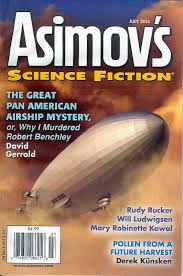
Asimov's July 2015
As the leaves begin to drop and the warm summer nights finally give way to the chill of autumn, it's time to review ... oh, wait, it's December already, and I'm still on the July issue. Never mind, I never promised you a rose garden, so let's crack on.
Mary Robinette Kowal delivers the lead novelette, "Like Native Things" and it's a nastily clever take on the idea of humans being able to jack into the nervous systems of other animals. Tilda, the scientist protagonist, is duped by bad-guy Helmut into gaining access to the experimental wetware control system of a dolphin, so that he can commit a terrorist act. The plot is simple: Tilda realises what's happened, and then has to scramble to use whatever wetware-controlled animals she can (octopus, puma and so on) to get to Hector before he achieves his aim. It's basically just an extended chase scene, conventionally - and breathlessly - told, with Tilda hopping from one animal body to another, but I hadn't seen anything quite like it before. It does all get a bit Scooby-Doo with the bad guys talking to each other in a way that very helpfully explains their plans (while Tilda overhears), but it's still fun, doesn't outstay its welcome, and I liked the ending.
David Gerrold has been part of the field for as long as I've been alive, but having read very little of his work I was interested to see how I got on with the next novelette, which is "The Great Pan American Airship Mystery, or Why Murdered Robert Benchley." My first thought, before going into the story, was what does Gerrold have against the guy who wrote Jaws? Being thick, I didn't know anything about the "real" Robert Benchley, nor very much about the Algonquin Round Table, and to a large degree - given the centrality of the Algonquins to this alternate history confection - I can't really judge how well Gerrold hits the voices and mannerisms he's aiming for. That said, on its own terms, it's perfectly enjoyable, and along the way gets into some mildly clever metafictional games. Beyond that, I can't really say all that much, other than that if there were false notes, I was too tin-eared to pick them up.
"Acres of Perhaps" by Will Ludwigsen is a likable piece that riffs off events surrounding an imaginary TV series in the vein of The Twilight Zone or The Outer Limits. On my first read, I couldn't get on with at all, but something clicked and I found it much more to my taste when I gave it a second go. With that in mind, it's worth adding that I'm perfectly aware that one or even two reads won't always be sufficient to pull the good stuff out of a story, so if I've dismissed a piece or two during these reviews, I'm more than willing to accept that it may just have been me. Anyway, "Acres of Perhaps" focuses on the strange background of David Findley, the resident genius on the writing team, the one who had the real creative spark, as opposed to the reliable plodder of the narrator, who can pull stories out of his hat on demand, but never quite hits the weird heights of Findley's material. What's nice about this story is that, instead of just telling us that Findley wrote weird, imaginative episodes of the show, we actually get given specific examples of what they were like. Things take a decidedly Twilight Zone-esque twist when Findley's strange, Hill-billy-type family show up on set and demand to take him home, where he'll be much happier. I liked it.
"Petroglyph Man" by Rudy Rucker is another in a long line of stoned, gonzo surfer-dude Rucker pieces, this time about a new tech app called Benthos that somehow peels back reality to show what we're really thinking or feeling. If you take a photo using Benthos with your smartphone, the app distorts the eventual picture to reflect a sitation's "vibes" rather than the literal truth. Yeah. You'd better read the story, because it starts weird and then gets weirder, especially when the titular Petroglyph Man shows up. But if you like Rucker - as I do - then that's no hardship, and the story does actually have a good old romantic resolution.
By far the longest piece in the issue, Derek Kunsken's "Pollen from a Future Harvest", is a dense, knotty, twisty story about political machinations on a distant planet where human scientists and military types (with a strong African background) are engaged in the study of a very alien indigenous lifeform, the so-called "vegetable intelligences". Kunsken's story centres around the existence of a natural time-gate, which allows certain forms of information to slip back by eleven years - a feature which the vegetable intelligences have incorporated into their genetic biology at a very intricate level, using gene-coded pollen which blows back through the gate and allows their past and future selves to experience a kind of continuous but ever mutating present, spanning twenty two years between its leading and trailing edges. Naturally the human investigators are very interested in using this capability to further their own political ends. Although told in quite traditional terms, it's stylish and exceedingly convincing in its imagined details, with exactly the right kind of off-hand jargon and theorizing to make the time-gate concept seem entirely plausible. I also liked the oppressive, paranoid atmosphere of the foreground narrative, with Major Okonkwo detailed to "audit" the sudden loss of pollen transmissions from the future, leading to an edgy, nervous investigation with echoes of cold-war spy thrillers. It reminded me, in the best way, of both the anthropological SF of Ian Watson and the early, icy hard SF of Gregory Benford. According to the introduction it's the second entry in a series exploring the biology of the vegetable intelligences, but while the ins-and-outs of the political gamesmanship occasionally lost me, I didn't feel that I necessarily needed to have read the earlier installment. I enjoyed Kunsken's early story in Asimov's this year, but this is even better.
Monday, 30 November 2015
Chasm City sketches
A sort-out of an old box turned up a notebook containing sketches and thoughts toward what eventually became Chasm City, my second novel. The notes were written - to the best of my knowledge - in early 1999. By that point I had already completed one draft of the book, but much of the sleeper ship subplot - Sky, the grubs and so on - was absent from the first version. These sketches were done as I thought my way into the more complex story that eventually figured in the final book.
![]() |
| Cross-section through Chasm City |
![]() |
| Canopy structure and cable-car |
![]() | ||
| Grub starship |
![]() |
| Grub ship interior cross-section |
![]() |
| Flotilla sleeper ship |
Monday, 9 November 2015
Star Wars
Over on File770, there's been some discussion about the way the SF community responded to Star Wars when it came out in 1977:
http://file770.com/?p=25931
Personally, I loved Star Wars with every beat of my heart and still do. What's often forgotten is that, over in the UK, we didn't get the film until early in 1978. I saw it on my twelth birthday, in Swansea, and I can still recollect pretty much every detail of both the film and the drive to and from it along the M4, past the alien nightscape of Port Talbot. I remember sitting in the back of the car and hearing Kate Bush on the radio - "Wuthering Heights" had been released in January of that year, and had hit the number one spot by the time my birthday rolled around. I hadn't seen a picture of Kate Bush at that point, but - even at twelve - I was mesmerised by her voice, and in my imagination she looked exactly like Princess Leia, down to the ear-muff hairdo.
I already knew about Princess Leia, though, because - even though the film hadn't come out - we'd been tormented by an incredibly long build-up. My first hint of the film had come a year earlier, I guess, when a brief clip had been played on one of the news programmes. It was a space battle scene but beyond that it didn't leave a huge mark on me. Some while later, my frend Stephen turned up with a glossy magazine, one of those Sunday supplement giveaway things, which had a colour spread about this new film that was taking America by the storm. The main picture was of an X-wing being shot at by a TIE-fighter, and I immediately knew it was the coolest thing I'd ever seen. The spaceships looked like the kinds of craft you'd seen in Space: 1999, but sleeker and even more dirtied-down. Real, basically, if such a thing were possible. And the rest of the article showed some of the characters, such as Darth Vader, Han Solo and so on. What struck me most forcibly, though, were the Stormtroopers. I didn't know what they were, except they looked like evil incarnate, with those skull-like helmets and their pristine white armour. There was something about that glossy white armour which made them about as terrifying as it was possible to imagine. I remember staring at them, trying to work out if they were robots or cyborgs or what. All I knew was that they were scary. From that point on, Star Wars had gone from something I was mildly interested in, to a burning, single-minded obsession. I had to know more. And I would.
Through that summer, I collected complete sets of both the blue and red-bordered bubble-gum cards. In that autumn, as I started at The Big School (Pencoed Comprehensive, where I still help out with creative writing workshops) I got hold of George Lucas's novel of the film. Yes, it was amazing, wasn't it, that George Lucas had not only found time to make this film, but also scribble down a novelisation of it? It was only later that Alan Dean Foster was credited, but not on my edition. It was a shiny paperback with a yellow cover and a set of colour photos stitched into the middle. It was a holy relic, as far as I was concerned, and when I accidentally dented one of the corners, I felt as if my world had ended. I also got the 7" disco-funk version of the Star Wars music:
https://en.wikipedia.org/wiki/Meco
Which was only the third record I'd ever bought, after the Jaws theme and Queen's We Are The Champions.
By early 1978, clips of the film had appeared on television many times and bits and pieces of additional merchandising were starting to appear. Stephen had the Marvel comics Star Wars editions, and we looked through them after school, gleaning clues. Slowly we were piecing together something of the experience to come. Nothing, though, could serve as adequate preparation for the film itself. From the beginning, it was different. There was the familiar 20th Century Fox intro, but - astonishingly - the music had an additional flourish, one that I'd never heard before, and all because Lucas had insisted on using the Alfred Newman fanfare:
https://en.wikipedia.org/wiki/20th_Century_Fox
Of the film itself, there isn't much to say that hasn't been said a million times before. The ships, the speed, the colour, the spectacle - it was all bigger, louder, faster, than anything I'd seen before. One thing sticks in my mind, though. No one had prepared us for the doors! The doors on the Death Star, the Falcon etc - they closed so quickly! For some reason that had never come across in any of the TV clips and yet it seemed so important to the texture of the film, adding a real sense of menace. You didn't want to be stuck under those doors when they came rocketing down.
I didn't have any Star Wars toys as such, but the day after I did what we all did in the seventies: I made it up out of Lego. I made Lego X-wings, Lego Tie-Fighters, and even arranged some boxes to create a makeshift "Trench" to send them shooting down. Later I would get more ambitious and make Lego Imperial Cruisers and even a Lego Millennium Falcon, complete with a row of white bricks at the back to simulate the exhaust glow. It was fantastic.
I saw Star Wars one more time, and then that was it - the long, long wait for the sequel. I didn't stop being obsessed with Star Wars. I read "Splinter of the Mind's Eye", Alan Dean Foster's sequel, imagining - as I think did a lot of us - that this was what the next film was going to be about, and in truth found it a bit boring and bewildering. It was with some relief that hints began to surface that the next film wasn't going to be like that at all. There were huge walking machines in it, and a battle on an ice planet. Great! When "The Empire Strikes Back" came out in 1980, I went to see it, again in Swansea, once with my family and the second time on the train with a friend. I thought it was brilliant, but it left me with a strange melancholic feeling at the end. I was 14 by then, and starting to read "proper" grown-up science fiction, but I could still enjoy Star Wars perfectly well on its own terms. By the time the next film came out, in 1983, I was seventeen, old enough to go to pubs, trying to write my own stuff. It was a different time, and although I enjoyed the speeder bikes and space battles, the magic wasn't quite there for me any more. But I still retained a basic affection for the films and their characters, and years later, almost by an effort of will, I forced myself to find some meagre crumbs of enjoyment in the rightly derided prequels. I'm still a Star Wars fan, you see. It doesn't bother me in the slightest that Star Wars isn't really science fiction, in the sense that we usually prefer to see it. Worrying about that is like worrying about whether ice cream is pudding. It is what it is - good in parts, silly in others, occasionally great and wonderful, and in that respect my view of it isn't hasn't shifted all that radically in nearly forty years. Give me a huge spaceship cruising in from upper screen right, give me that bass rumble, give me a tiny ship trying to outrun the larger one ... and I'm sold.
Oh, and I still like Kate Bush.
http://file770.com/?p=25931
Personally, I loved Star Wars with every beat of my heart and still do. What's often forgotten is that, over in the UK, we didn't get the film until early in 1978. I saw it on my twelth birthday, in Swansea, and I can still recollect pretty much every detail of both the film and the drive to and from it along the M4, past the alien nightscape of Port Talbot. I remember sitting in the back of the car and hearing Kate Bush on the radio - "Wuthering Heights" had been released in January of that year, and had hit the number one spot by the time my birthday rolled around. I hadn't seen a picture of Kate Bush at that point, but - even at twelve - I was mesmerised by her voice, and in my imagination she looked exactly like Princess Leia, down to the ear-muff hairdo.
I already knew about Princess Leia, though, because - even though the film hadn't come out - we'd been tormented by an incredibly long build-up. My first hint of the film had come a year earlier, I guess, when a brief clip had been played on one of the news programmes. It was a space battle scene but beyond that it didn't leave a huge mark on me. Some while later, my frend Stephen turned up with a glossy magazine, one of those Sunday supplement giveaway things, which had a colour spread about this new film that was taking America by the storm. The main picture was of an X-wing being shot at by a TIE-fighter, and I immediately knew it was the coolest thing I'd ever seen. The spaceships looked like the kinds of craft you'd seen in Space: 1999, but sleeker and even more dirtied-down. Real, basically, if such a thing were possible. And the rest of the article showed some of the characters, such as Darth Vader, Han Solo and so on. What struck me most forcibly, though, were the Stormtroopers. I didn't know what they were, except they looked like evil incarnate, with those skull-like helmets and their pristine white armour. There was something about that glossy white armour which made them about as terrifying as it was possible to imagine. I remember staring at them, trying to work out if they were robots or cyborgs or what. All I knew was that they were scary. From that point on, Star Wars had gone from something I was mildly interested in, to a burning, single-minded obsession. I had to know more. And I would.
Through that summer, I collected complete sets of both the blue and red-bordered bubble-gum cards. In that autumn, as I started at The Big School (Pencoed Comprehensive, where I still help out with creative writing workshops) I got hold of George Lucas's novel of the film. Yes, it was amazing, wasn't it, that George Lucas had not only found time to make this film, but also scribble down a novelisation of it? It was only later that Alan Dean Foster was credited, but not on my edition. It was a shiny paperback with a yellow cover and a set of colour photos stitched into the middle. It was a holy relic, as far as I was concerned, and when I accidentally dented one of the corners, I felt as if my world had ended. I also got the 7" disco-funk version of the Star Wars music:
https://en.wikipedia.org/wiki/Meco
Which was only the third record I'd ever bought, after the Jaws theme and Queen's We Are The Champions.
By early 1978, clips of the film had appeared on television many times and bits and pieces of additional merchandising were starting to appear. Stephen had the Marvel comics Star Wars editions, and we looked through them after school, gleaning clues. Slowly we were piecing together something of the experience to come. Nothing, though, could serve as adequate preparation for the film itself. From the beginning, it was different. There was the familiar 20th Century Fox intro, but - astonishingly - the music had an additional flourish, one that I'd never heard before, and all because Lucas had insisted on using the Alfred Newman fanfare:
https://en.wikipedia.org/wiki/20th_Century_Fox
Of the film itself, there isn't much to say that hasn't been said a million times before. The ships, the speed, the colour, the spectacle - it was all bigger, louder, faster, than anything I'd seen before. One thing sticks in my mind, though. No one had prepared us for the doors! The doors on the Death Star, the Falcon etc - they closed so quickly! For some reason that had never come across in any of the TV clips and yet it seemed so important to the texture of the film, adding a real sense of menace. You didn't want to be stuck under those doors when they came rocketing down.
I didn't have any Star Wars toys as such, but the day after I did what we all did in the seventies: I made it up out of Lego. I made Lego X-wings, Lego Tie-Fighters, and even arranged some boxes to create a makeshift "Trench" to send them shooting down. Later I would get more ambitious and make Lego Imperial Cruisers and even a Lego Millennium Falcon, complete with a row of white bricks at the back to simulate the exhaust glow. It was fantastic.
I saw Star Wars one more time, and then that was it - the long, long wait for the sequel. I didn't stop being obsessed with Star Wars. I read "Splinter of the Mind's Eye", Alan Dean Foster's sequel, imagining - as I think did a lot of us - that this was what the next film was going to be about, and in truth found it a bit boring and bewildering. It was with some relief that hints began to surface that the next film wasn't going to be like that at all. There were huge walking machines in it, and a battle on an ice planet. Great! When "The Empire Strikes Back" came out in 1980, I went to see it, again in Swansea, once with my family and the second time on the train with a friend. I thought it was brilliant, but it left me with a strange melancholic feeling at the end. I was 14 by then, and starting to read "proper" grown-up science fiction, but I could still enjoy Star Wars perfectly well on its own terms. By the time the next film came out, in 1983, I was seventeen, old enough to go to pubs, trying to write my own stuff. It was a different time, and although I enjoyed the speeder bikes and space battles, the magic wasn't quite there for me any more. But I still retained a basic affection for the films and their characters, and years later, almost by an effort of will, I forced myself to find some meagre crumbs of enjoyment in the rightly derided prequels. I'm still a Star Wars fan, you see. It doesn't bother me in the slightest that Star Wars isn't really science fiction, in the sense that we usually prefer to see it. Worrying about that is like worrying about whether ice cream is pudding. It is what it is - good in parts, silly in others, occasionally great and wonderful, and in that respect my view of it isn't hasn't shifted all that radically in nearly forty years. Give me a huge spaceship cruising in from upper screen right, give me that bass rumble, give me a tiny ship trying to outrun the larger one ... and I'm sold.
Oh, and I still like Kate Bush.
Thursday, 5 November 2015
Asimovs - April/May 2015 double issue
As I alluded to in my review of the June issue, I had to set this one aside for the time being due to losing my physical copy of the magazine. I'd been reading it during a trip to Geekopolis, the big multimedia comvention in Paris, and to the best of my recollection I must have set it down on a table during an interview and then left it there. Sheila Williams, the editor of Asimov's, very kindly sent me a pdf of the edition but that brought its own complications. I could only read it on a laptop, and that meant the occasions when I normally read Asimov's - bedtime, bus rides, train rides etc - were out of the question. It took me longer to get through than normal, not helped by the double issue containing much more fiction than the usual editions.
I also found - to my regret - that quite a bit of the fiction in this issue just wasn't to my taste on any level, but there were still a handful of stories I could get behind. I also decided to make a pragmatic call - if a particular story was turning into a serious struggle, I gave it two or three goes before abandoning it.
Unfortunately - for me, anyway - the lead story in this issue, "The New Mother" by Eugene Fischer, was one of those pieces I couldn't finish. I did try. It's an extremely lengthy account of the emergence of a strange new sexually transmitted pandemic that gives rise to diploid eggs, allowing for "virgin" births. It's competently told - there's nothing clumsy about it on a line by line or even page by page level - but the net result is, to my eyes, dull, diagrammatic storytelling, propped up by lengthy infodumps in the form of article excerpts. If you've ever wondered how the American medical system would respond to the kind of pandemic outlined in the story, it's probably accurate enough in its imagined details, but despite two goes I couldn't get more than a few dozen pages into it. I wasn't engaged by the journalist protagonist, her situation, her travels, the dull-but-credible dialogue. The stuff I want from short science fiction - colour, pace, weirdness, estrangement, invention, language, mood ... it's all absent here. Sorry.
Onto "Day Job" by the respected veteran author Tom Purdom, whose work I've enjoyed in the past ... but not here, I'm afraid. Following on the heels of "The New Mother", it's another story which has a kind of plausible-but-dull "TV Movie of the week" feel to it. It's all very grey and uninvolving, with a pointlessly large cast of characters and viewpoints, but no real sense of place or texture. It's just dialogue, action, dialogue, action, all the way through. It's about some kind of psychological retraining scheme allowing borderline sociopaths to function in the normal workplace ... I think. But again I gave it two goes before my eyes glazed over.
It's a blessed relief to turn to the Swanwick/Frost collaboration. Michael Swanwick (along with Allen Steele, who also has a story in this issue) provided a kind endorsement for my story "Slow Bullets", so feel to free to disregard my opinion, but "Lock up your Chickens..." is what I want from short science fiction, in that it's weird, colourful, different, does significant things with voice - while being incidentally laugh-out-loud funny - but it's also the kind of story that immediately offers reassurance that you're in the hands of writers who know what they're doing, who know how to sustain narrative interest, handle pace and so on. It's a kind of depression-era tale of itinerant con-men, H'ard and Andy, and I enjoyed it entirely on its own merits, completely oblivious to the fact that the characters are an affectionate take on the personalities of the real writers Howard Waldrop and Andy Duncan, something I only learned when I shared a panel with Michael Swanwick at a recent convention. It's not groundbreaking stuff, it's not going to storm the awards shortlists (I think) but it's fun and funny and technically assured.
Just when things are looking up, we come to "Paul and his Son" by Joe M. McDermott, which I'm afraid I couldn't get on with at all. I read it twice, too, from beginning to end. It's all over the place. Set a decade or two from now, I'd guess, it's about a father who's come up through the era of global over-medication, and now there's a kind of backlash, in that the next generation are having to make their way into the world without being medicated ... and the story hinges on the father's efforts to track down an illegal, imported drug which he thinks will make life easier for his son. The son, incidentally, is also called Paul - a pointless, confusing complication which serves no purpose at all, other than to have the reader constantly backtracking up a line or two to see which Paul is being referred to. The narrative voice is that of the older Paul, but it's tonally inconsistent, and unfortunately quite clumsily written, with too many commas, sub-clauses and rhetorical questions. The story proceeds to an underwhelming conclusion, and I'm sorry to say it's one of the weaker pieces of short fiction I've encountered in my recent reading.
My friend and one-time collaborator Liz Williams delivers a short but vivid vignette in "The Marriage of the Sea", which like much of Liz's fiction straddles the Vancean border between science fiction and fantasy, preferring to leave much unexplained. This piece deals with a sacrificial ritual that takes a wayward turn, and there's not really much more to be said other than the writing is sharp and descriptive, with Wiliam's usual control of language. I particularly liked "an air of ghastly festivity", but you'd need to read the piece to get the context.
I've long enjoyed Robert Reed's work, both at novel and shorter length. He's extraordinarly prolific, and if his stories don't always light a spark, they're always delivered with a certain panache, a certain minimum level of competence, and you can be sure that they'll embed at least one or two very clever insights. "What I Intend" probably isn't classic Reed but it's reliably interesting and insightful, offering a breathtaking new take on the age-old question of SETI, the search for extraterrestrial intelligence. Reed revisits the famous "Wow" signal, then spins off from that to speculate that there might be "Wow" signals going on all the time, if only we had the capacity to detect them, and then goes a step further to come up with a genuinely original, bracing and bleak idea of What It Might All Mean.
Anna Tambour's "The Gun Between The Veryush and The Cloud Mothers" starts off intriguingly enough, with a potentially evocative off-world setting involving a low-tech tribal society but with a lingering sense that there's some sort of science fictional premise lurking not too far away. But it soon shifts viewpoint (why?) and gets bogged down in interminably dull stuff involving priests and acolytes and lots of made-up names, and I'm afraid I found it impenetrably dull and earnest, and was not able to get very far into it. I don't demand that a story grab me on the first line, or even the first page, but something's got to give me a reason to keep turning the pages and simply getting to the bottom of someone else's worldbuilding, no matter how intricate or thought-through, isn't going to do it. I've said it before in earlier reviews, but I don't understand why so many writers seem intent on using multiple points of view in short fiction, even at novelette or novella length. What works in a novel works against the effectiveness of short fiction.
Bloody hell, I sound harsh, don't I?
"Willing Flesh" by Jay O'Connell isn't anything exceptional, but at least there's only one point of view, and the tone is perfectly suited to the material. It's a clever premise: a fat dude signs up for a dodgy weight-loss program that involves much more than he bargained for. Like all these things, it starts well, then goes off the rails. There were some odd dialogue glitches in this pieced where I found it hard to determine who was speaking, but that's a small observation. The story doesn't have a knock-out ending but it's enjoyable enough because it's not trying to do nine zilllion things at once.
I enjoyed "How to Walk through Graveyards in the Post-Digital Age" by Fran Wilde rather a lot, without quite being sure I got to the bottom of it. There's some really smart, inventive stuff in this story, which blends the after-effects of post-war cybernetic surgery (involving some nasty but plausible speculation about memories being deleted or suppressed for military security reasons) with what might - just - be an actual, honest to god ghost story. I don't mind not getting everything on a first pass through a story, provided the writing gives me the assurance that there are additional levels, and in this case the piece has that necessary sheen of competence.
"The Sentry" by Frank Smith also deals with the after-effects of war, but in this case the premise struck me as much less plausible. It's the twenty fifth century, supposedly, and we're out in the solar system, where the moons of Saturn, such as Tethys, have been terraformed (good luck with that, I was thinking). It's a quiet piece, in its way, dealing with a veteran of the war and his reactions to a violent but innocent event in a domestic context - the family dog mauls a rabbit - but the telling, and the details, are such that the story could easily be transplanted to 2015 with very little effort, all the more so because we're told that, despite it being the twenty fifth century, people still watch baseball and use the commonplace American slang of the present day.
Allen M Steele's "The Children of Gal" is the long concluding piece in this issue, and it's very much in the tradition of classic SF stories such as Clarke's "Against the Fall of Night", in that we start with an insular, cut-off society that does not properly understood its origins or nature, and a protagonist breaks away from the immediate confines to get a better understanding of their place in the universe. Steele is too much of an old hand to put a foot wrong here, and from the outset we're given a reason to keep turning the pages. In its way, it starts off from a similar place to the Anna Tambour story, but Steele holds his focus on one character and gives us a reason to care about their immediate predicament. In this case, the boy's mother has been shamed and exiled after claiming - against the accepted rules of her island culture - to have seen a light moving through the sky. Of course we're intrigued, and when the mother returns from her exile - impossibly, it seems - we follow the protagonist as he comes to a richer apprehension of the nature of his world. Once the mother returns, there's surprisingly little jeopardy, and - as the protagonist meets the beings responsible for that moving light - things begin to creak a little under the weight of exposition. Oddly, I didn't much care. Perhaps it's because the story moves so smoothly, or simply that Steele's voice is so engaging, that it doesn't really matter that at least half the story simply consists of the protagonist being shown and told exciting stuff. This story, incidentally, is part a larger narrative that Steele is developing, but it reads satisfyingly enough on its own terms.
So there you are - the April/May double issue. I disliked rather more of the stories than I expected to, but on the upside, there's still some good, solid stuff here and I went on to be rather more appreciative of the June issue.
Friday, 23 October 2015
Russia
![]() |
| Looking down Nevsky Prospekt, St Petersburg, on a cloudless late summer evening. |
So I went to Russia, and it was great.
I was invited to be a guest at the Saint Petersburg Science Fiction Assembly, a small but friendly gathering of fans taking place in mid August. It came at the end of an exceptionally busy summer for me, the culmination of a year in which, at one point at least, I had been working on three novels at the same time. By August I had thinned that down to just the one novel, but I was still far from done with it and I left for Russia with considerable trepidation, aware of the work ahead of me between then and the end of September. I took a laptop and vowed to come back with ten thousand words of new material by the end of the trip.
My wife travelled with me to Saint Petersburg and we were both made very welcome by the Russian fans. Nataly and Nikolay met us at the airport on a glorious sunny afternoon, and I felt immediately at ease as soon as were in their company. The gathering actually took place a long way from the city itself, but we had been told as much and it wasn't any surprise when we ended up taking a lengthy car journey into the beautiful wooded countryside, both of us seeing Russia for the first time. My wife had passed through Moscow airport on her way to Mongolia once, but I'd never set foot within the borders of Russia, despite very nearly going on a school trip to the USSR in the late 1970s. Here we were, decades later. Our venue was the "Raivola", a kind of holiday camp, with huge chalets and a very impressive central building where we ate and did all the talks and panels.
![]() |
| Your author ponders a particularly searching question from the audience. Look, you can tell it's Russia. |
The Raivola (which my brain kept insisting on translating as "ravioli") had a great buffet meal set-up which meant that we were never in any danger of starving. In fact the main problem was eating too much, and despite the many paths winding around the grounds of the camp, I only managed one rather pathetic run during the whole trip. During our meals we were always made welcome by the Russian fans and the whole atmosphere was exceedingly relaxed and convivial. I did a few discussions and interviews, a reading (for which translated text had been made available ahead of time - a very good idea) and also sat in on one or two other discussions, not being shy of sticking my oar in when I recognised a book title or authour name amid the stream of Russian. My hosts took all this very graciously.
![]() |
| Friendly faces. |
![]() |
| Your author makes a shameless bid for attention with one of his shiny Russian editions. |
The Raivola trip had been in my thoughts for at least a year, but it was over all too soon, and before long we were on our way back to Saint Petersburg. Again we were very well taken care by our drivers Tina and (on the way back to the airport) Elena. The trip wasn't over for my wife and I, though, as we'd booked some extra days in the heart of the city, a destination we'd wanted to visit for many years, and as well as spending some extra time with Nikolay, a resident of Saint Petersburg, it was also a chance to meet my Russian editor Alexander Guzman.
My wife and I are big on art, and we'd long wanted to visit the Hermitage. I can safely say that it was everything we'd hoped it would be, times about ten, and although we went back for a second day, you could cheerfully spend a month in the place and not see enough.
![]() |
| Looking through an arch to the main building of the Hermitage |
![]() | ||
| The General Staff Building is part of the Hermitage, located opposite the main museum. |
![]() |
| Detail of Renoir's Young Woman With Fan. |
We also visited the Russian museum, which was equally phenomenal. You couldn't do justice to it in a week, let alone a day. Oddly, though - and this also applied to the General Staff Building - once you were in, you couldn't get a coffee! Personally, as much as I love art, I need a sit down and a break after an hour or two of wandering galleries. Never mind, though, as Saint Petersburg was hardly lacking in cafes:
![]() |
| Contemplating the selection of cakes in a nicely understated establishment. |
![]() |
| Another cake. So good to look at I hardly dared start eating it. But with a massive effort of will, I succeeded. |
Beer was also on my mind when I met the SF Assembly fans again in a British-style pub not too far from the main railway station. It was really enjoyable. My wife and I also hooked up with Nikolay again for a lovely evening, and on another evening I spent a very enjoyable few hours with Alexander, who introduced me to the editorial offices where my Russian editions are published. After that, we went on something of a pub crawl, which was great fun. Thank you to Alexander, Nikolay and all who made our stay so pleasant.
With a couple of spare hours one afternoon, we took our chances with the Saint Petersburg metro system and went to visit "Grand Maket Rossiya", supposedly one of the top tourist attractions in the city. It's a huge version of Russia in miniature, with model trains and cars zipping around everywhere. It was crowded, and seemed very popular. Unfortunately we didn't have a chance to see it all but what we managed to look at was fantastically entertaining and I could have gladly spent a day there.
I risked a shot of this Russian military facility:
![]() |
| Russian Bear taxiing. |
I've really only scratched the surface of our trip, but it was a really illuminating experience and we enjoyed every minute of it. I consider myself very fortunate to be in a position where I am invited to places like this, and treated so well. Thank you, SF Assembly, and thank you, SF fandom in general.
![]() |
| Subway entrance. |
![]() |
| Poster for a stage version of The Master & Margarita. |
ps - and what about those 10,000 words I promised myself? Not a chance!
Subscribe to:
Posts (Atom)