Friday, 23 October 2015

Russia

Looking down Nevsky Prospekt, St Petersburg, on a cloudless late summer evening.


So I went to Russia, and it was great.

I was invited to be a guest at the Saint Petersburg Science Fiction Assembly, a small but friendly gathering of fans taking place in mid August. It came at the end of an exceptionally busy summer for me, the culmination of a year in which, at one point at least, I had been working on three novels at the same time. By August I had thinned that down to just the one novel, but I was still far from done with it and I left for Russia with considerable trepidation, aware of the work ahead of me between then and the end of September. I took a laptop and vowed to come back with ten thousand words of new material by the end of the trip.

My wife travelled with me to Saint Petersburg and we were both made very welcome by the Russian fans. Nataly and Nikolay met us at the airport on a glorious sunny afternoon, and I felt immediately at ease as soon as were in their company. The gathering actually took place a long way from the city itself, but we had been told as much and it wasn't any surprise when we ended up taking a lengthy car journey into the beautiful wooded countryside, both of us seeing Russia for the first time. My wife had passed through Moscow airport on her way to Mongolia once, but I'd never set foot within the borders of Russia, despite very nearly going on a school trip to the USSR in the late 1970s. Here we were, decades later. Our venue was the "Raivola", a kind of holiday camp, with huge chalets and a very impressive central building where we ate and did all the talks and panels.

Your author ponders a particularly searching question from the audience. Look, you can tell it's Russia.


The Raivola (which my brain kept insisting on translating as "ravioli") had a great buffet meal set-up which meant that we were never in any danger of starving. In fact the main problem was eating too much, and despite the many paths winding around the grounds of the camp, I only managed one rather pathetic run during the whole trip. During our meals we were always made welcome by the Russian fans and the whole atmosphere was exceedingly relaxed and convivial. I did a few discussions and interviews, a reading (for which translated text had been made available ahead of time - a very good idea) and also sat in on one or two other discussions, not being shy of sticking my oar in when I recognised a book title or authour name amid the stream of Russian. My hosts took all this very graciously.

Friendly faces.

Your author makes a shameless bid for attention with one of his shiny Russian editions.


The Raivola trip had been in my thoughts for at least a year, but it was over all too soon, and before long we were on our way back to Saint Petersburg. Again we were very well taken care by our drivers Tina and (on the way back to the airport) Elena. The trip wasn't over for my wife and I, though, as we'd booked some extra days in the heart of the city, a destination we'd wanted to visit for many years, and as well as spending some extra time with Nikolay, a resident of Saint Petersburg, it was also a chance to meet my Russian editor Alexander Guzman.

My wife and I are big on art, and we'd long wanted to visit the Hermitage. I can safely say that it was everything we'd hoped it would be, times about ten, and although we went back for a second day, you could cheerfully spend a month in the place and not see enough.

Looking through an arch to the main building of the Hermitage


The General Staff Building is part of the Hermitage, located opposite the main museum.

Being fans of impressionism and post-impressionism, we were particularly drawn to the General Staff Building which - internally, at least - is considerably more austere than the main part of the Hermitage, but houses a totally breathtaking collection of some of the greatest paintings in the history of art.

Detail of Renoir's Young Woman With Fan.

We also visited the Russian museum, which was equally phenomenal. You couldn't do justice to it in a week, let alone a day. Oddly, though - and this also applied to the General Staff Building - once you were in, you couldn't get a coffee! Personally, as much as I love art, I need a sit down and a break after an hour or two of wandering galleries. Never mind, though, as Saint Petersburg was hardly lacking in cafes:

Contemplating the selection of cakes in a nicely understated establishment.
Another cake. So good to look at I hardly dared start eating it. But with a massive effort of will, I succeeded.
Eating and drinking was always a pleasure, and we dined out very well during our trip. Perhaps the most enjoyable meal we had in the city itself was on our first night, in a lovely, snug restaurant called "Maisha and Bear". It was brilliant. Caviar on toast to begin with (about seven pounds a head), followed by Chicken Kiev for my wife and Beef Stroganoff for me, all washed down with some rather nice local beer.

Beer was also on my mind when I met the SF Assembly fans again in a British-style pub not too far from the main railway station. It was really enjoyable. My wife and I also hooked up with Nikolay again for a lovely evening, and on another evening I spent a very enjoyable few hours with Alexander, who introduced me to the editorial offices where my Russian editions are published. After that, we went on something of a pub crawl, which was great fun. Thank you to Alexander, Nikolay and all who made our stay so pleasant.

With a couple of spare hours one afternoon, we took our chances with the Saint Petersburg metro system and went to visit "Grand Maket Rossiya", supposedly one of the top tourist attractions in the city. It's a huge version of Russia in miniature, with model trains and cars zipping around everywhere. It was crowded, and seemed very popular. Unfortunately we didn't have a chance to see it all but what we managed to look at was fantastically entertaining and I could have gladly spent a day there.

 I risked a shot of this Russian military facility:

Russian Bear taxiing.

 I've really only scratched the surface of our trip, but it was a really illuminating experience and we enjoyed every minute of it. I consider myself very fortunate to be in a position where I am invited to places like this, and treated so well. Thank you, SF Assembly, and thank you, SF fandom in general.

Subway entrance.


Poster for a stage version of The Master & Margarita.

ps - and what about those 10,000 words I promised myself? Not a chance!


Thursday, 22 October 2015

Asimovs - June 2015


At the start of the year I began reviewing 2015's run of Asimov's Science Fiction, but I was careful not to make any rash promises about delivering those reviews in anything like a timely fashion. My efforts to read the April/May double issue came acropper when I lost my copy of the magazine in Paris, and although editor Sheila Williams very kindly sent me a pdf of the issue, for various boring technical reasons, I can only read pdfs in my office - and I've had a novel to finish in the meantime. As it happens I'm just about done with the double issue but in the meantime I thought I'd skip ahead a month and do the June edition first.

With my own short fiction reading being so spotty in recent years - part of the reason I started this exercise - I came to this issue completely unfamiliar with any of the contributors, having not knowingly read anything by any of them before. As such, I'm pleased to say that I found it a generally strong issue, with a nicely varied selection of stories.

The lead story is "The End of the War" by Django Wexler, and it's military science fiction with a space-based setting. No, come back - it's actually pretty inventive, with an effective evocation of combat between different vessels equipped with advanced nanotech weapons. The war has been going on a long time:

The salvage isn't anything to write home about. It's a seventh-generation wetship, probably a destroyer. The second or third generation ships were profligate with materials - heavy metals, exotica, even organics - and are thus the most valuable targets for harvesting. By the seventh generation, resources were already getting scarce, and there's less worth digging out of the old hull.

There's nothing startling about the narrative choices made here, but the story's effective enough as it stands, if you can get past the overload of jargon and tech-talk. When I encounter a piece like this, though - told in the first person -  I'm more and more minded to ask myself - exactly who is being spoken to, and under which circumstances? I'm as guilty as anyone of making unexamined viewpoint choices in my fiction, but it's definitely something that preoccupies me more as I get older, and I can't help wondering how often these decisions aren't underpinned by any deeper considerations of form and intent, but are rather made on the spur of the moment, simply because a story feels like it'll work better one way than the other.

Henry Lien's "The Lady's Aquatic Gardening Society" is note-perfect in its evocation of the starched manners of high nineteeth century society. Dealing with an escalating feud between two almost equally dreadful women engaged in vicious social oneupmanship, I can't help wondering whether it owes something to the wonderful Mapp and Lucia stories of EF Benson.  The arch, comedic tone is very similar. But - although it doesn't become immediately clear until rather late in the story - it is science fiction, of a sort, and this tit-for-tat game eventually has (literally) world-changing consequences. If I've complained in previous reviews of a certain sameness of voice in many of these stories, that's not an issue here - the evocation of a certain ghastly social set is excellently done and sustained without a slip. If there's one problem with the piece, it's that the tone, once established, doesn't vary to any significant degree, leading to a certain monotony of effect as the story progresses. I also felt that the back-and-forth snidiness between the two main protagonists, while effective enough, wasn't quite as sharp and steely as it should have been. But these are minor quibbles and I enjoyed the piece very much.

"Mutability", by Ray Nayler, takes its time with some extremely indulgent scene-setting, almost the kind of leisurely opening you'd expect in a novel, but once it kicks into gear it's an effective and somewhat warm meditation on the limits of memory, especially (as is the case here) in the very long-lived. In this future society, medical longevity has granted people many centuries of life, but the "horizon" of their memories is a constantly moving front which only reaches back so far. It's a fascinating idea which I've seen touched on elsewhere, but Nayler makes it the focus of the story and the ramifications are explored to full effect. It's also a rather touching love story, with - gasp - a happy ending, of all things. I'd need to read it again to pick apart the degree to which coincidence drives the story, but that wouldn't be any particular hardship.

Krasnikov Tubes! Who doesn't love a science fiction story featuring Krasnivok Tubes, eh? Oh well, perhaps it's just me. Anyway, "The Muses of Shuyedan-18" by Indrapramit Das is a nicely  inventive piece about some human explorers studying an exceeding weird alien ecosystem on a distant planet accessed by aforesaid Tubes. Tani and Mi are two female members of this expeditionary team, sent out from their "exoprot" base into the field to conduct observations of the reproductive cycle of a vast and strange alien organism loosely translated as a "lifecastle". Against the norms of their exoprot culture, illicit lovers Tani and Mi rashly decide to have sex in their transparent camp-tent and are witnessed by the alien, which then commemorates the act by shaping humanoid sculptures or "mindcarvings" into its own flesh. The problem for Tani and Mi is that their act is now enshrined on the side of the alien, there to be discovered by another surveyor from their colony. The story plays out from this incident, with flashbacks to the early days of Tani and Mi's relationship. There's nothing terribly groundbreaking in the voice or narrative choices here, but the story's salted with many nicely evocative details, and manages to feel about as up-to-date as any first contact piece you're likely to encounter, proof if any were needed that there are always new stories to be told.

I struggled slightly with "Ghosts of the Savannah" by M. Bennardo. There's nothing clumsy or incoherent about the story, but throughout it I had the nagging sense that I was missing something obvious, and perhaps I was. On the face of it, it's a piece of fiction set in prehistoric times, involving a hunter-gatherer culture, and centering on two sisters - Sedu and the (I think) unnamed narrator - who are much better at running and hunting than the males of their village, and not terribly keen on the idea of settling down to a life of childbearing. When Sedu runs into trouble after sustaining an accident, the narrator has to lie to her village to protect her sister.  It could just be a straight evocation of ancient human times - the setting is clearly Africa, since there are gazelles, ibis and so on - but there are odd details which confound that simple picture. The girls are orphans, and we don't learn too much about their origins. They're afflicted, if that's the word, with Secret Voices and Secret Senses - but then so (it seems) are all the other members of the village. When Sedu breaks a bone in her leg, we're led to believe that she could be up and walking again in mere days. What are we to make of that? It's not just Sedu who has that seemingly magical capacity for rapid healing, but all the others. Is it just because they're tough, or is something else going on? Are they time travellers, who've forgotten their origin? Aliens? Is it the future, and their bodies are stuffed with self-repairing nanotech? I couldn't work it out, and when the narrator drops this seemingly out-of-place observation into the text:

Can the sharpest-eyed hunters see the tiny pinprick of our fire glimmering in the dark? Do they know what it means? Or is it just another distant mystery, another alien enigma in the night? A new phenomenon with no cause or effect, to be catalogued and named and avoided by every sensible human?

I found myself none the wiser. There's also an earnestness of tone to this piece which makes for somewhat dull reading - it's all too suggestive of a creative writing assignment - "imagine yourself in the mind of a prehistoric hunter-gatherer" -  lacking humour or zest or any real spark that jolts the senses. I don't want to be too critical, though, because it's unfair to dismiss a story on the basis of one reading, and it's entirely possible - probable, even - that I missed something that was will be glaringly obvious to other readers.

The last and best story in the issue, in my view, is the piece by Sarah Pinsker. Entitled "Our Lady of the Open Road", it's nothing more than an account of a few days in the life of a travelling rock band, in an era when actual live music has beem more or less squeezed to the margins by ubiquitous hologram playback technology. The band - a trio - are making their way through the backroads of Middle America in a much-loved but elderly touring van modified to run on cooking oil, and the story confines itself to their day to day hassles of finding food, keeping clean, fuelling the van and getting gigs in various scuzzy dives. What's great about this story is that, although the stakes aren't terribly high, it's told with such complete conviction and attention to detail that we do come to care about the future of the band, and when the lead singer has to make a difficult choice about the band's financial set-up, we're fully invested in her dilemma. It's full of nicely authentic details, too, such as the correct protocols for taking towels from hotel rooms. What stands out more than anything, though, is the affection that the band members feel both for each other and their van. It's also dead-on about a certain son of New Jersey:

Down at the other end, two blonde women stood facing the Bruce holo, singing along and swaying. He pointed in their general direction, and one giggled and clutched her friend's arm as if he had singled her out personally. Two guys sat on stools near the stage, one playing air drums, the other watching the women. The women only had eyes for Bruce.

I got where they were coming from. I knew people who didn't like his voice or his songs, but I didn't know anybody, especially any musician, who couldn't appreciate his stage presence.

Amen to that.


Thursday, 24 September 2015

Slow Bullets and the Canopus Award.

A week or two ago I was very pleased to learn that Slow Bullets had been shortlisted for the inaugural Canopus Award:

http://100yss.org/news/press

I was asked not to release the news until the 100 Year Starship organisation had put out its own press release about the shortlisting.

Unfortunately, I missed an important detail. Slow Bullets had been nominated in the long-form category, and I failed to notice that the cutoff was for works longer than 40,000 words. Slow Bullets is actually a bit under 40,000 words, bringing it into the novella category as defined by such things as the Hugo award. We (my editors and I) actually worked pretty hard to make sure that was the case, as the original version of the story was quite a bit longer than 40,000. I was also keen not to concern my mainstream publishers by bringing out what would technically have been a novel from another press. Yes, I know these categories are somewhat arbitrary, but they do matter.

The 100YSS people were extremely good about this, and were happy to let the shortlist stand as it was, but I felt that in this instance it was necessary to draw a clear distinction between novella and novel, and allowing it to remain on the shortlist would have blurred that distinction. To that end, I've asked for the piece to be withdrawn. To reiterate, the fault was mine for not spotting the category glitch in the first place, and I'm sorry for any embarrassment it may have caused to either Tachyon Press or the 100 Year Starship organisation. In any case, it was very pleasant to have the nomination, and I wish the best of luck to the finalists in all the categories.

Friday, 28 August 2015

Tomislav Tikulin

Tomislav Tikulin is a Croatian artist who has just had his first book published, by SST press. If you've been collecting some of my limited editions and chapbooks, you'll have already encountered Tomislav's fine work on the covers of Troika, Thousandth Night and so on.


I liked Tomislav's work from the outset, and when SST asked me for a quote for the new book, I was happy to provide an endorsement, of which this is a partial quote:

"It's been my great privilege to see Tomislav's artwork illustrating my stories. So much contemporary fantastic illustration is meticulously rendered, but also rather sterile and unengaging, but Tomislav's work is the exact opposite of that, with a real sense of texture and emotional depth."

The hardcover book, divided into roughly two halves - SF and fantasy - is terrific, and an excellent showcase of this talented and versatile artist. If you doubt me, then I'd point you to the equally effusive endorsements by the likes of Peter Crowther, Christopher Golden, Eric Brown and Trevor Quachri. If you have any SF artbooks in your collection, this is definitely one for the shelf.

SST press:

https://www.sstpublications.co.uk/

Tuesday, 14 July 2015

Frank Sidebottom and the Snows of Pluto

One of my most treasured posessions is this record from 1986, Frank Sidebottom's epoch-defining "sci-fi ep":


Other than containing some of the most inspired interpretations of popular sci-fi themes ever committed to vinyl - Frank's 2-second long "The Theme Tune from Close Encounters of the Third Kind" is particularly noteworthy -  Frank was thoughtful enough to include some cutting edge "science fact". Here's the rear cover:


Among other choice factoids, Frank informs us that the Sun is "very big and very very hot", the moon is "not very interesting" and that the universe is believed to be made of "solid blamonge" beyond its edge. No arguing with any of that. However, Frank was really on the money when it came to Pluto:


Note Frank's prescient statement that it is "always snowing" on Pluto - a prediction that may turn out to be uncannily accurate in the light of recent data. What did Frank know that the rest of us didn't? Frank was also good enough to include a handy "check list" - "tick off the planets as man visits them (I have started it)" with Norwich crossed out. As Frank said: "Keep this sleeve by your radio and TV and as news comes through about mans' trips to other worlds - you'll have an instant record close at hand."

Cheers, Frank.

https://en.wikipedia.org/wiki/Chris_Sievey


Saturday, 4 July 2015

Books, books, books

Not a great deal to report here, hence the silence. But that doesn't mean it hasn't been a busy month or so since the last update.

Steve Baxter and I delivered our collaborative novel - the sequel to Arthur C Clarke's "A Meeting with Medusa" - at the start of June. At the moment we're to-ing and fro-ing between "The Medusa Chronicles" and "The Medusa Centuries" for the title, but that should be settled before too long. At various points Steve and I have used both titles, but we were always aware that we'd have to commit to one over the other at some point. We'll be working on the editorial revisions to the book over the coming month or so. At 130,000 words it's a decent sized novel, although not in the doorstopper class, and I wouldn't be surprised if the wordage drops a little as we go through the revisions. Since the Clarke story that provided  the inspiration for our novel is itself not terribly long (I'm guessing it's a long novelette or a short novella, although I haven't done an exact word count) we both felt that we wanted to retain that spirit of concision and not end up writing an unwieldy blockbuster. That said, Clarke's story gave us so many avenues to explore that at times it was hard to rein ourselves in. And it's very much a sequel to the story, not - as I've seen mentioned here and there - an expansion. No; Clarke did it first and best, and Steve and I were agreed that we didn't want to touch a word of the original. What we've done, instead, is spin off from the last line of that story, imagining what happened to Howard Falcon after he came back from Jupiter.

In the meantime, I'm working on my next novel, which will also appear in 2016. The collaboration is very much a bonus, which Steve and I both knew would have to be worked in around our existing contractual obligations, and it's had no bearing on the other books we're both working on. From my point of view, it's probably meant a little less short fiction being written in 2015, as well as a lot less travel, but since I had a good run last year, I don't think that's too bad a trade-off. As for the as-yet-unfinished book, I don't want to say too much about it at the moment, because there's still - as they say - a mountain to climb - and a lot could change between now and delivery. It's a standalone, though, and not related to anything else I've written, and will (I hope) turn out to be something fast-paced, colourful and not least of all fun.

If that wasn't enough, I'm also turning my thoughts - very gently - to the book after this one, and that one will be a return to one of my prior universes. Which one, it's too soon to say.  I'll probably have a better idea nearer the end of the year. Of course, these decisions don't take place in a vacuum.  Editors, agents, marketing departments, etc, also have to think that it's a commercially sound idea, and although we've begun negotiations, so to speak, there's still a way to go before I have a definite book and title in mind.


Sunday, 31 May 2015

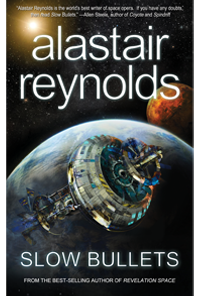
Slow Bullets


Tomorrow is the official publication day of my chapbook novella "Slow Bullets", which I'm very pleased to have published with Tachyon Press, ably assisted by my editor on the project, Marty Halpern. At just a shade under 40,000 words, it's not quite novel-length by the usual rules, but it is certainly at the long end of short fiction.

Like many of my stories, this one had a very long gestation. For several years I'd been playing around with two completely separate story ideas. The first concerned a prison ship, loaded with an assortment of the good, the bad and the ugly, suddenly catapulted into a situation where only the collective wisdom of those on board is going to save the day. I could see the opening scenes in my head - a battle-scarred planet, soldiers and POWs being loaded onto transports, former enemies forced into close confinement with each other. Then something goes wrong...

But that was as far as it went; all I had was the outline, not a stab at the material, as I knew that something was missing.

The second idea was also only a series of outlines. I'd become fixated on the idea of scribes, of regiments of monk-like scholars being forced to transfer information from one medium to another, by hand ... I could see them sitting in the hulk of a crashed ship, half submerged in some alien sea, trying to preserve as much knowledge as possible from the ship's dying memory. Perhaps they'd been doing this for long that they barely remembered what the ship was, or where it had come from ... all that mattered was the task of transcription. The monks had to work to the point of exhaustion, though, because on some level time was against them.

But again, I couldn't go from those outlines/images to a story; I knew that the story would fail unless I found the missing element.

There matters rested. One evening in early 2012 my wife and I were out for the evening - we'd gone into town to see a performance by Holiday on Ice. We got to our seats early and there wasn't much to do until the presentation started. With the lights still up, and people still filtering in from outside, my mind started wandering. That was when I realised that those two story ideas each formed the missing half of the other. I wasn't trying to write two stories, I was trying to write one ... and now the only problem was to integrate the two ideas into a single narrative.

The performance started. I enjoyed it, but some part of my mind was busy beavering away on the connections between those two story ideas. One by one the pieces began to fit together. By the end of the evening, I was in no doubt that I could write the implied story. I knew it was going to be a larger piece - a novelette or maybe even a novella. But even then I didn't anticipate that it would still make me more than a year, and that the finished article would be closer to 50,000 than 40,000 words.

When Marty Halpern contacted me in April 2013, asking about the possibility of a novella for Tachyon Books, it was already more than a year since I'd found a way to merge the two ideas ... and it would be the better part of a year again before Marty had the story. At one point I rewrote the entire thing without using a single comma or quotation mark... before sense prevailed.

And here we are a year later again, with the book now shipping.

Here are some early reactions and reviews:


“Alastair Reynolds’ new novella Slow Bullets has the scope of a much longer work (Edward Gibbon’s The Decline and Fall of the Roman Empires, say), the literary speed of the most rapidly hurtling bullet, and so many provocative scientific  and / or philosophical ideas that even Stephen Hawking’s head might well spin with them. Moreover, Reynolds artfully compresses all these disparate elements into a portable trade paperback or a weightless e-file, the better to accommodate our busy reading habits and the more fully to entertain us.

“Let me also note that Slow Bullets posits a far-future situation akin to the one that we confront on planet Earth today, but leavens his fictional crisis with a hard-won grasp of human psychology and a down-to-the-ground optimism that bestows on its readers reasons for supposing our ‘dammed human race’ nimble enough to overcome our demanding real-world crisis du jour. A fine example of the true science fictionist’s art . . . ‘with a bullet,’ as the editors at Billboard Magazine  used to say.”
—Michael Bishop, author of A Funeral for the Eyes of Fire, And Strange at Ecbatan                                                                                                                        the Trees, and Transfigurations

“Alastair Reynolds is the world’s best writer of space opera. If you have any doubts, then read Slow Bullets.”
—Allen Steele, author of Coyote and Spindrift

“The writing is tight, the characters are well developed, and the story itself moves along at a cracking pace.”
—Science Fiction & Fantasy Book Corner

 “Slow Bullets  is classic science fiction, a space opera, a puzzle story, a character study, visionary science fiction, and a prayer for peace.  I see no reason why you should not love it.”
—Michael Swanwick, author of Tales of Old Earth and Dancing with Bears

“Alastair Reynolds weaves a tapestry of dark, dystopian societies in a tense, colorful narrative.”
—New York Journal of Books

“It’s a more intimate vision than what I encountered until now in Reynolds’ books, but for this very reason it felt more profound and poignant than any other I read so far, and it gave me a new level of interpretation for this author, and a key to a new way of reading his stories. Highly recommended, both for Reynolds’ admirers and as an introduction to this author.”
—Space and Sorcery

“Slow Bullets is a tightly focused tale that moves forward at a brisk and entertaining pace. It is a satisfying story of survival mixed with an intriguing mystery.”
—HoloWriting


You can order Slow Bullets from Tachyon Press:

https://tachyonpublications.com/product/slow-bullets/

Or from Amazon.com:

http://www.amazon.com/Slow-Bullets-Alastair-Reynolds/dp/1616961937/ref=sr_1_1?ie=UTF8&qid=1433090576&sr=8-1&keywords=slow+bullets

And if you want the Audible version from the good people at Tantor:

https://tantor.com/slow-bullets-alastair-reynolds.html

http://www.amazon.com/Slow-Bullets/dp/B00XWSP4LM/ref=sr_1_1_twi_2_audd?ie=UTF8&qid=1433090840&sr=8-1&keywords=slow+bullets

Thank you again to Marty, Jacob, and all at Tachyon and Tantor for making this possible.