I'm out and about in the UK quite a bit this month.
The evening of this coming Wednesday, 6th November, I'll be speaking at the Institute of Physics in Derby:
http://derbyiop.eventbrite.co.uk/
I'll also be signing at Waterstones Derby from 2 - 3 pm on the same day.
The following Thursday, 7th November, I'll be speaking at the Cambridge University Science Fiction and Fantasy Society in, unsurprisingly, Cambridge.
http://cusfs.soc.srcf.net/home
I'm not entirely sure how it works if you are not a member of the society or the university itself, I'm afraid, but I imagine they'd be welcoming. Best to phone ahead, though.
As if that wasn't enough excitement, I'll be in Nottingham a week later to talk to university's science fiction and fantasy society, on Friday 15th November. The talk is scheduled to start at 7.00pm.
http://www.su-web.nottingham.ac.uk/~scifi/
Finally, at the end of the month on Thursday 28th November I'll be in Glenrothes, Fife, talking about Doctor Who and other things:
http://www.onfife.com/events/cosmic-thrills-alastair-reynolds-rothes-halls-library
Hope to see some of you at one of these events.
Monday, 4 November 2013

Thursday, 17 October 2013
Newport State of Mind
This weekend I'll be participating in Space, Time, Machine and Monster, a literary festival in Newport, South Wales.
http://www.literaturewales.org/space-time-machine-and-monster/
Quoting from the website:
"Following a hugely successful first outing in Pontypridd in 2008, the Space, Time, Machine & Monster literary festival returns for two days packed full of science-fiction, fantasy and horror. Expect talks, workshops, film screenings, panel events and competitions for adults, teens and your little horrors.
Event highlights include a talk with Rhianna Pratchett on the world of narrative gaming; and Page to Screen: Sci-fi, Fantasy and Horror with Catherine Bray who is currently editor of Film4.com and a regular guest presenter on BBC1′s Film 2013 With Claudia Winkleman. Plus, discover the real science behind Doctor Who with Mark Brake and Jon Chase and explore the work of Arthur Machen and J.R.R. Tolkien with Catherine Fisher, Gwilym Games and Dimitra Fimi.
There will also be the chance to explore the world of Warhammer and take part in a series of battles waging throughout the day, or you could create your own animated alien universe, zombie comic and even your own origami Star Wars character. The programme features a top line-up of speakers, authors and illustrators including, Huw Aaron, Ben Aaronovitch, Horatio Clare, Jasper Fforde, Catherine Fisher, Gwyneth Lewis, Alastair Reynolds, Stephen Volk and many more.
Bestselling fantasy author Jasper Fforde commented: "There are clearly not enough zombies or Time Travel in South Wales, and I am delighted to see Literature Wales addressing that imbalance"
I note also that the excellent Adam Roberts will also be attending. My events are on the Saturday, and I look forward to seeing some of you there.
Tuesday, 15 October 2013
Two Trunks
According to popular wisdom, all writers have at least one early and unpublished book that is best consigned to obscurity - the so called "trunk novel", the idea being that you keep it locked away in a trunk rather than doing the sensible thing and binning it. According to another branch of popular wisdom, the first thing writers do when they're stuck for inspiration is dust off a trunk novel and pass it off as a fresh new book. I'm sure that happens occasionally, but I suspect the truth is that most writers would rather throw themselves under a bus than see their juvenile work reaching print. More probably, I'd suggest, we look on these things as part of the necessary learning curve of becoming a fluent writer - we don't have to admire them, or even like them, but we can understand that they were an essential part of our literary development that we had to pass through. There may even be elements of these unpublished works that, with a little recasting, can still filter through into our professional work.
My two trunk novels don't live in a trunk and while they're not exactly representative of where I'm "at" as a writer in 2013, I'm certainly not ashamed of them. I keep them on the same shelves as all my other written works, and look on them with a sort of tolerant fondness. I take them to schools and libraries and pass them around. I don't have any illusions as to the quality of the books, but I am proud that I started and finished them. They were vital stepping stones on my path to becoming a published writer, and if they served one useful function, it was to cure me of any fear of The Novel.
Here they are, in exactly the same ring folders in which I started them:

Exciting, aren't they? I bet you can't wait to see what's inside those enticingly patterned covers.
Wait no more, because here are the thrilling title pages:

The uppermost book, the one in the yellow Colman's Mustard folder, is "A Union World", which I wrote between 1979 and 1982. It took a long time because whenever I got to the end of the book, I hated the start. This initiated a Forth Bridge-like process of constant revision which might have gone on forever had I not decided to finally accept the book on its own terms and stop.
When I began "A Union World", my science fiction horizons were very limited. I enjoyed TV and cinema SF, 2000AD magazine, and had read a bit of Clarke and Asimov. But I was really pretty clueless. When I finished the book, my literary tastes had widened to include the likes of Larry Niven, Harry Harrison and James White - true eclecticism, I think you'll agree. During the late revisions, indeed, I tried very hard to emulate the tone and scope of Niven's Known Space sequence. The novel deals with the human space federation making first contact with a number of different alien factions. It has colony worlds, FTL, robots, space battle fleets and so on. The plot, such as it is, revolves around a military research base on a distant colony world, which has mysteriously severed all contact with Earth. In a setup surprisingly similar to the opening act of Aliens, the Colonial forces decide to send in an assault ship full of elite soldiers to retake the base and establish what has happened, and in doing so recruit (or rather blackmail) a civilian pilot into helping them out. It turns out that the civilan's creaky old space freighter has an outmoded drive system which means it's the only ship that can enter the planet's atmosphere undetected, enabling the troops' dropship to be placed close to the compromised base. Later on we discover than an alien mastermind has taken control of the base, plans to enshroud it in a force field, and use planet-destroying bombs to literally shatter the entire rest of the planet, so that the base becomes a free-flying space fortress. This all happens! Later, predictably, there's an enormous space battle between the combine forces of Earth and the flying space fortress. There's even a space-aircraft-carrier called the Ark Royal.
The second book, entitled "Dominant Species", is of similar length and takes place in the same universe. But I wrote it in a much shorter span of time compared to the first. My recollection is that I started it very late in 1983 and finished it somewhere around the Spring of 1984 - in other words, in a few months rather than a few years. The upside of that intense burst of creativity was that the book was much more uniform in its style, and actually had a plot that made a kind of sense. The downside is that I really should have been studying for my 'A' levels in 1984, which I duly failed in spectacular fashion. But at least I had a novel to show for it.
Both books are handwritten in their entirety, on lined A4 paper, in black biro:

I've still got a bit of a thing about black biro: I can't be doing with blue at all. I also used a tankerload of Tip-Ex correction fluid, and where that wasn't practicable, I either rewrote the entire page (front and back) or glued a small insert over the offending section. Years later, I'd go through a very similar process of cutting and pasting while preparing the artwork for my PhD thesis, so the experience certainly wasn't wasted.
I shan't say too much about the second book, except that it picks up the story of the human expansion a bit later on, and there are some more aliens and giant flying space things. Neither book takes place in the Revelation Space universe, incidentally, but a lot the furniture and character names of the RS stories show up here for the first time. Most of the planet names, as well as some of what would be later be principle characters in Revelation Space such as Sajaki and Captain John Brannigan, but here in very different roles.
Speaking of which:

At the time I wrote the second book, I was heavily influenced by the "fake documents" style of Joe Haldeman's second novel, Mindbridge, and so I made up a few fake documents and logos to be inserted into the text. Looks fantastically convincing, doesn't it? I'm sure they'll still be using typewriters with sticky ribbons in 2332, and won't yet have solved that tricky "right justification" problem.
Wednesday, 18 September 2013
Incoming
ON THE STEEL BREEZE is only ten days from UK publication, and at least one bookseller seems to have copies in stock already, although they may not yet be for sale. Having just returned from America, and with my post still to be collected from my neighbour, it's entirely possible that there might be a finished copy in my mail as well. I'll find out soon enough. It's always a sobering moment, the first time you hold the end product. Months or years of work, distilled into a rectangle of card and paper. This is it - no more changes now.
It seems odd to have said so little about this book, but I swore some time ago that I would avoid talking it to death before publication, a trap I suspect I fell slightly into with Blue Remembered Earth. On the other hand, I'm genuinely excited to see what the world makes of it. And, of course, not a little nervous about that same reception. This is the middle book of the "Poseidon's Children" trilogy but, from my standpoint at least, it feels like quite a different book to its predecessor. In my more pretentious moments, I've suggested that this is the darker second movement of a symphony, and there's no doubt that, in parts, the book is markedly more violent and dystopian than Blue Remembered Earth. If BRE explored some unabashedly utopian ideas, then OTSB offers a sort of critique or reflection on where some of those trends might end up given another century or two of development. Yes, stuff goes wrong in this book. Bad stuff happens to people, people do bad things to each other, and there are deaths - quite a lot of them, in fact. That's not to say that it's an out-and-out dystopia, any more than the real world of 2013 is. But there's a good deal of peril, there are ominous developments, and things that we might have thought we understood at the end of BRE turn out to be ... otherwise, and not always in ways we might have wished.
I'm tempted to say more (in fact, I've just deleted a paragraph of expository waffle, telling you all about Chiku Akinya, my central character) but I shall refrain. In the meantime, the prologue and three chapters of the novel are now available to read on the Gollancz website, and here are the links:
http://www.gollancz.co.uk/2013/09/on-the-steel-breeze-chapter-1/
http://www.gollancz.co.uk/2013/09/on-the-steel-breeze-chapter-2/
http://www.gollancz.co.uk/2013/09/on-the-steel-breeze-chapter-3-and-founding-fathers-of-rocketry/
Hope you enjoy these excerpts, and (if you soldier through them) that they provide some incentive to read the whole book.
Sunday, 15 September 2013
Remember the Alamo
I enjoyed the World Science Fiction Convention in San Antonio. As always, I'm left with slightly mixed feelings about what I expect to get out of such a gathering, as well as what I'm actually bringing to the show by being there. But there's no doubt that from my perspective as a writer and program participant, it all seemed well organised. The convention centre was, from a British viewpoint, typically huge and at times bewildering in its layout. I never did make it to the Green Room. But the panels seemed to be well attended and judging by the feedback, enjoyed by both participants and audience members. After two attendees were not able to make it, the panel on SF art and artists as writers turned out to be just Joe Haldeman and myself, but we enjoyed ourselves and I think we kept it just the right side of self-indulgence. Luckily, because I wasn't very well prepared, Joe had brought some examples of his own art along.
I did a few other program items but the one that will stick in my memory was the panel on the legacy of Iain Banks and the Culture books. Ably moderated by Vince Docherty, the panel also included Kim Stanley Robinson, Ben Jeapes and myself. In his opening remarks, Vincent stated that a female panelist had been unable to attend, which was why Ben had come on at short notice. (For the record, I'm not hugely bothered about panel parity on a given topic provided there is a good shot at balance across a convention's entire programming track, but it was good to hear that efforts had been made). What made this panel memorable, in my view, was that for once none of us were there to promote our own works or careers - not that my fellow panelists would have been so crass as to do that anyway, but it was one hundred percent Iain and his legacy that we were there to discuss. It was an honour and a privelege and I hope we rose to the occasion. I knew Iain only slightly, as I've written elsewhere, and I don't think Ben had met him. But we had all been saddened by his death, and brought to a renewed appreciation for the huge body of work he left us. Stan Robinson, though, had known Iain much more closely, and over a much longer span of time. It was wonderful to hear Stan's thoughts on both the books and the man. SF is much the poorer for Iain's passing, a fact that I think will only become more evident as time passes.
I didn't go to the Hugo ceremony, so I missed the controversy, such as it was. My wife was in town with me, but since she did not have an attending membership, we decided to go to see a film instead - Elysium, during which I mostly slept. I couldn't summon tremendous enthusiasm for the Hugo evening anyway. Some undeniably good works were nominated, and I didn't sense any great outpouring of anger after the results. I'd have liked 2312 to do well, certainly, but John Scalzi has been such a force for good in the field, taking a genuinely heroic stand, that I doubt anyone would have much begrudged his win for Redshirts, quite aside from the fact that it had many admirers. The fact is, though, that I didn't even vote. I just couldn't summon up the enthusiasm or the energy, in a professionally difficult year in which I'd read almost nothing eligible and in which the one book I did rate highly - 2312 - was to some extent likely to overshadow my own eligible novel, Blue Remembered Earth. (Stan's is the better novel, though - go and read it). I needn't have worried, though. When the full Hugo results were made available, nothing of mine had come to close to being nominated, let alone winning. Normally there's a work or two of mine somewhere down below the cutoff, which is enough to provide some crumb of consolation, but this year there was nothing. I suppose I shouldn't be too surprised - I've made plain my thoughts on SF's year-long awards circus - but it was sobering all the same, as if my entire SF career was happening in some parallel world entirely removed from the Hugos. To be fair, I have had one Hugo nomination, for Troika back in 2011, for which I was genuinely grateful, and which is one more Nebula nomination than I've managed to notch up in 23 years of professional publishing. All of which probably sounds bitter, but actually I'm more bemused than disappointed. I do well enough commercially, and people whose opinions matter to me occasionally say nice things about my fiction. My short fiction is widely reprinted and anthologised. But the field has two conspicuous badges of merit, the Hugos and the Nebulas, and judging by those I'm just barely on the map.
Rather than end on a downbeat note, though, I'll reiterate that I enjoyed the convention very much. I appreciated the work that went in behind the scenes, and I saw a lot of people having a great time. I was personally disappointed that my friends from Helsinki did not succeed in winning their bid for 2015, but - hey - London is next. And awards or otherwise, I hope to be there.
Thursday, 5 September 2013
Chiefly nocturnal

Eagle Owl caption, Field museum of natural history, Chicago. I have no idea why the upright image insists on displaying like this, but I'll fix it when I return to the UK. Among many things about the wonderful Field museum, I loved that they had made no attempt to update the dated diction and tone of their older captions. I wish more museums kept faith with the past in this fashion, rather than constantly chasing an ever decreasing attention span. "This results in the discomfiture of the owl", indeed.
Friday, 16 August 2013
ISS
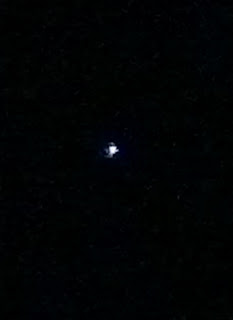
Unless you're on it, the International Space Station is a long way away - 400 or more km, even if it's flying right overhead - but on the other hand, it's huge. Modern digital cameras and lenses can do surprisingly well at capturing images of such a large and distant object, so - having been impressed by some of the pictures I've seen on the web - I thought I'd have a go myself.
This is my first proper effort -I tried a couple of nights ago with my camera on automatic mode, but the battery was low and in the low light conditions I struggled with finding the focus at infinity (my camera has a continuous focussing dial, so there's no handy end-stop). Tonight I set the ISO to 800 and the shutter speed to 1/500th, and focused on the Moon and a couple of stars beforehand. My cameras is a Lumix FZ50 with a 1.5 teleconverter on top of the built-in 420mm lens. The sky was clear except for some cirrus and the pass was a bright one. I balanced my camera on a wheelie-bin, as I've seen mentioned elsewhere - good tip. A tripod is not much use as you can't track fast enough to keep on the station.
What do you reckon? It looks like I've resolved something more than a smudge, but I admit it's not very scientific. Next time, I'll take a sequence of exposures at the same angle and see if there's any consistency between the images.
Enlargement:

This is my first proper effort -I tried a couple of nights ago with my camera on automatic mode, but the battery was low and in the low light conditions I struggled with finding the focus at infinity (my camera has a continuous focussing dial, so there's no handy end-stop). Tonight I set the ISO to 800 and the shutter speed to 1/500th, and focused on the Moon and a couple of stars beforehand. My cameras is a Lumix FZ50 with a 1.5 teleconverter on top of the built-in 420mm lens. The sky was clear except for some cirrus and the pass was a bright one. I balanced my camera on a wheelie-bin, as I've seen mentioned elsewhere - good tip. A tripod is not much use as you can't track fast enough to keep on the station.
What do you reckon? It looks like I've resolved something more than a smudge, but I admit it's not very scientific. Next time, I'll take a sequence of exposures at the same angle and see if there's any consistency between the images.

Enlargement:

Subscribe to:
Posts (Atom)